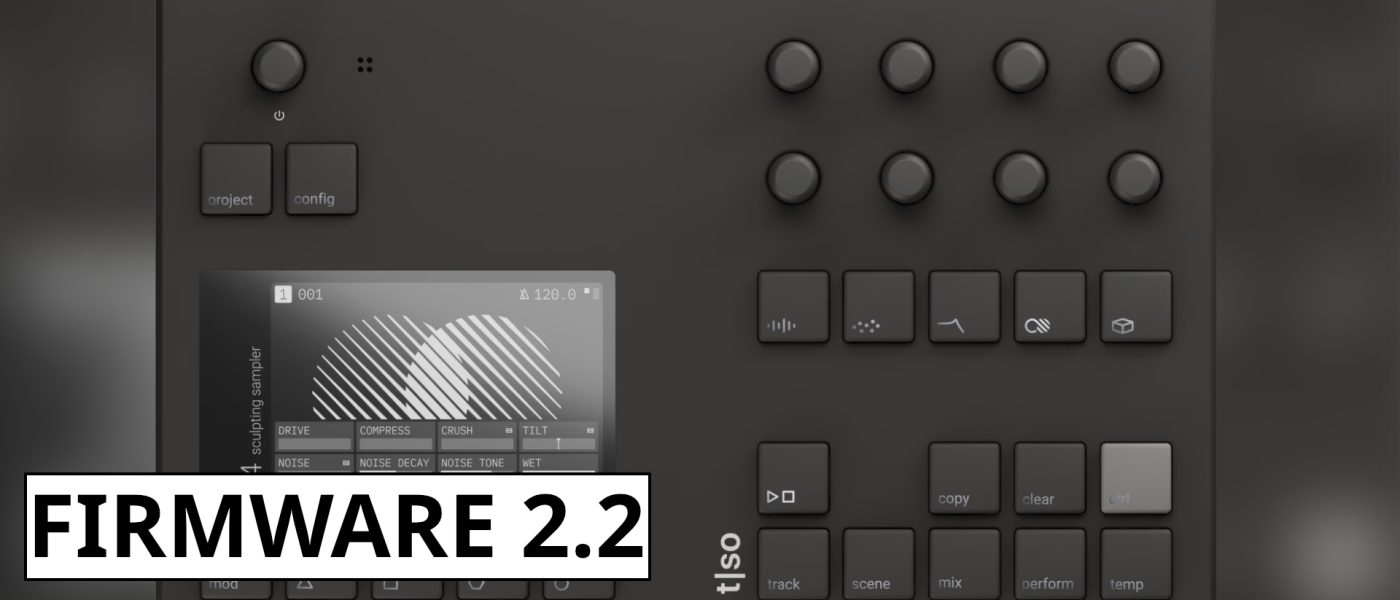
TL;DR: Torso Electronics has released firmware 2.2 for the S-4 sculpting sampler, now in beta as a free download. The update significantly deepens the granular engine with scan parameter, position mode, syncable delay, and randomization for pitch, amplitude, and reverse playback.
- New granular engine capabilities: scan through looped audio with real-time time stretching, manual position selection, and syncable delay effects.
- Randomization added for pitch (stereo/mono), amplitude, and reverse playback probability.
- Firmware 2.2 builds on the major revision 2.0, which introduced macro controls, scenes, disk streaming, and envelope follower.
- Available now as a free beta download for existing S-4 owners; final release pending community testing.
- S-4 hardware retails at €899 and combines sampler, tape workflow, resonators, and granular processing in a unique form factor.
Reading time: 4 min
Want more synth news before your next coffee break? Join the Noxal newsletter — no spam, just gear worth knowing about.

The granular revolution continues

We at Noxal have a soft spot for gear that evolves. Too many synths and samplers arrive with a feature set that’s set in stone, leaving early adopters to wonder if their purchase will ever feel complete. Torso Electronics, to their credit, has taken a different path with the S-4 sculpting sampler. The device launched with ambition — and with bugs, missing features, and a community that felt, understandably, a bit burned. But firmware 2.0 was the turning point, a ground-up rewrite that finally delivered on the original promise. Now firmware 2.2 is here, and it’s making the granular engine genuinely deep.
Let’s talk about that granular engine. The S-4’s Mosaic device is where you sculpt audio into clouds, textures, and rhythmic glitches. Version 2.2 introduces a new scan parameter that lets you sweep through looped audio and choose exactly where in the buffer the grains are read. You can do this with real-time time stretching, and if you throw modulation at it — LFOs, envelopes, the works — you get results that range from beautifully unpredictable to outright chaotic. For those of us who live in the space between control and happy accident, this is a gift.
There’s also a position mode, where you manually specify the buffer position from which the S-4 starts reading. Think of it as pointing a microscope at a specific moment in your sample and saying, “Here. Right here.” It’s precise, it’s intuitive, and it makes granular sound design feel less like guesswork and more like sculpting.
Keeping it fresh: randomness and delay
One of the criticisms I’ve heard about the S-4 in its early days was that its sound design palette could feel limited. Firmware 2.2 addresses that head-on by adding randomization to pitch (both stereo and mono), amplitude, and reverse playback. The reverse playback parameter is particularly clever: you dial in a percentage chance that individual grains will play backwards. At low settings, it’s a subtle texture. Crank it up, and you’re in full glitch territory.
The new syncable delay mode is another highlight. It turns the granular engine into a delay effect where grains are repeated in time with your project tempo. This isn’t your average ping-pong delay — it’s granular delay, meaning each repeat can be a different slice of the buffer, with randomized pitch or amplitude if you want. The result is a delay that feels alive, shifting with every repeat. I’ve spent more time than I care to admit just feeding a single chord into the S-4 and letting granular delay do its thing. It’s the kind of feature that makes you forget you’re supposed to be making a track.
These additions, combined with the ability to load the buffer to hold any moment in time, mean the S-4’s granular engine is now flexible enough to satisfy both sound designers and live performers. It’s no longer a one-trick pony — it’s a modular playground.
The major rewrite: firmware 2.0
To understand why firmware 2.2 matters, you have to appreciate the foundation laid by version 2.0. That update was a total rewrite of the core engine, and it brought features that the S-4 should have launched with. Macro controls let you map any parameter to eight performance knobs and four punch-in effect buttons — essential for live tweaking. Scenes allow you to save and instantly launch parameter and sample snapshots, up to 128 per project, controllable via MIDI Program Change. The Temp function is a beautiful piece of design: it temporarily overrides all parameters, snapping back to the saved state when released. It’s like a “reset to safety” button that encourages experimentation.
Disk streaming was another game-changer. The Disc device streams audio directly from internal storage, enabling playback of long-form files — full stems, field recordings, hour-long ambient drones. The only limit is your storage space. For someone like me, who hoards field recordings like coffee beans, this is transformative. The envelope follower (Follow) uses the amplitude of any track output or input to modulate parameters, adding dynamic responsiveness that makes the S-4 feel like an instrument that listens to you.
These weren’t minor tweaks. They were the difference between a promising prototype and a mature instrument. And now, with firmware 2.2, Torso is proving that they’re not done yet.
Who is this for, and why it matters
Let’s be honest: the S-4 isn’t for everyone. At €899, it’s competing with samplers that have decades of ecosystem support. If you want a straightforward sample player with a familiar workflow, there are cheaper, more established options. But the S-4 is for the person who wants to sculpt sound, not just trigger samples. It’s for the live performer who needs to twist a knob and watch the entire track transform. It’s for the sound designer who wants granular processing, resonators, and tape-style varispeed in one box.
We at Noxal appreciate that Torso Electronics has stuck with the S-4 through its rocky start. It would have been easy to abandon the project, to move on to the next shiny prototype. Instead, they rewrote the core engine, listened to users, and kept pushing. Firmware 2.2 is evidence that the S-4 is still maturing, and that’s rare in a hardware world that often treats firmware updates as bug fixes rather than creative expansions. If you already own an S-4, download the beta. If you’ve been on the fence, this might be the update that tips the scales. And if you’re still skeptical — well, I get it. But I’ve been watching this box evolve, and I’m starting to think it might be worth the caffeine-fueled obsession.
Frequently Asked Questions
Is the firmware 2.2 update free for existing S-4 owners?
Yes. Firmware 2.2 is currently in beta and available as a free download for all registered Torso Electronics S-4 users. The final release will also be free.
Does the granular engine in firmware 2.2 work with external audio inputs?
Yes. The granular engine processes audio from the buffer, which can be loaded from internal storage or recorded from the S-4’s inputs. The new scan and position modes work with any audio in the buffer, including live recordings.
Can I use the syncable granular delay in a live performance without a computer?
Absolutely. The syncable delay mode syncs to the S-4’s internal clock or external MIDI clock, making it fully usable in a standalone live setup. Combined with the macro controls and scene recall, it’s a powerful performance tool.
I’ll be honest: I’d been avoiding the S-4 because of the early reviews. But after watching firmware 2.2 in action, I’m starting to think I need another coffee — and maybe a credit card. The Noxal studio budget is going to need a rethink.