TL;DR: 1010music has unveiled the blackbox 2 at Superbooth 26, a major update to their beloved compact sampler. It boasts double the processing power, a refreshed design with a 4-inch color touchscreen, USB-C ports with multichannel audio, and battery operation — all for $649, arriving June 2026.
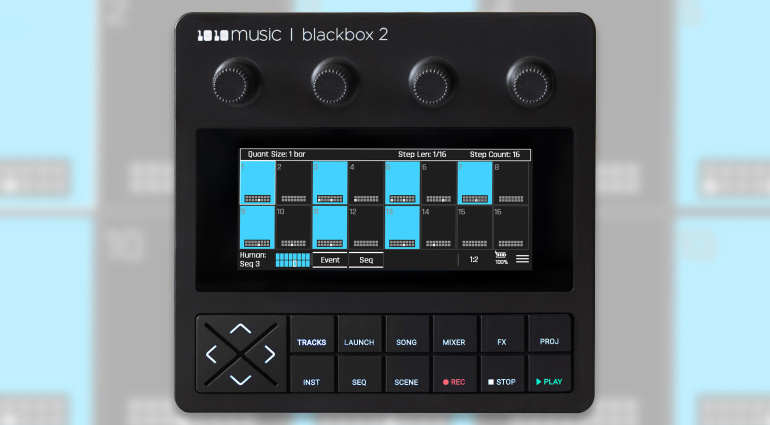
- New 4-inch color touch display with dedicated screens for Launch, Scene, Song, Mixing, and Effects.
- Double the processing power compared to the original blackbox, enabling smoother streaming of long WAV files and complex multisamples.
- Two USB-C ports (host and device) now support multichannel audio alongside MIDI, replacing the old USB-A and USB-B.
- Battery-powered operation for portable sessions, a first for the blackbox series.
- Priced at $649 with a June 2026 release date — a modest premium over the original.
Reading time: 3 min
Want more synth news before your next coffee break? Join the Noxal newsletter — no spam, just gear worth knowing about.

The Basics: What Is the blackbox 2?
Seven years. That’s how long we’ve waited for a proper sequel to one of the most versatile compact samplers in the game. The original 1010music blackbox carved out a loyal following by being exactly what it promised: a portable, touchscreen-driven sampler that could handle everything from one-shot drums to sprawling multisamples. It wasn’t flashy, but it was reliable — like that friend who always shows up with a full thermos of black coffee at 6 AM for a studio session.
The blackbox 2 picks up where its predecessor left off, but with enough upgrades to make even the most stubborn original owner raise an eyebrow. The headline feature is a 4-inch color touch display that replaces the old monochrome screen, but that’s just the beginning. The four encoders have migrated above the display, and the button layout has been rethought for faster navigation. It’s still unmistakably a blackbox, but one that’s clearly been through a design bootcamp.
At its core, the blackbox 2 remains a sampler and looper with support for one-shot, loop, slicer, and multisample instruments. You can load up to four of these per track, with up to 16 samples per patch in one-shot and loop modes. And yes, samples can be streamed directly from an SD card — a key feature for anyone working with long WAV files or complex multisample libraries without wanting to choke on buffer settings.
What’s New Under the Hood?
Let’s talk about the elephant in the room: processing power. 1010music claims the blackbox 2 offers “twice the power” of the original. That’s a vague metric, but in practical terms, it means smoother operation when juggling multiple streaming samples, faster patch loading, and less chance of audio dropouts during live sets. For a sampler that’s often used as a brain for live performances, this is more than a spec sheet flex — it’s a reliability guarantee.
The connectivity overhaul is perhaps the most practical upgrade. The old USB-A and USB-B ports are gone, replaced by two USB-C ports — one for host, one for device. Crucially, these now support multichannel audio alongside MIDI. This opens up the blackbox 2 as a multitrack audio interface, which is a game-changer for studio setups and mobile recording rigs. The TRS MIDI In/Out and Clock In/Out remain, but they’ve been consolidated into a single socket. Less cable spaghetti? We’ll take it.
Perhaps the most surprising addition is battery operation. The original blackbox was tethered to a wall outlet, which always felt like a missed opportunity for a device that fits in a backpack. The blackbox 2 can run on batteries, making it genuinely portable for field recording, live improvisation, or just jamming in a park while sipping a pour-over. The audio I/O remains unchanged — one stereo input, three stereo outputs, and a headphone jack — which is adequate but not groundbreaking.
Workflow and Live Performance Upgrades
If there’s one area where the blackbox 2 shines, it’s workflow refinement. The new dedicated screens for Launch, Scene, Song, Mixing, and Effects are a direct response to user feedback from live performers. Launch mode lets you trigger clips and scenes with minimal fuss; Song mode arranges scenes into a setlist; Mixing gives you per-track volume, pan, and effects sends. It’s all there, laid out in a way that doesn’t require a manual the size of a small phone book.
The Track screen now lets you load up to four instruments per track, and the automated multisample creation system for external instruments is a nice touch for sound designers. You can sample a hardware synth across its range and have the blackbox 2 automatically map the samples into playable multisamples. It’s not quite as seamless as something like a Korg Wavestate, but for a compact sampler under $700, it’s impressive.
For live performers, the ability to stream samples from an SD card means you can have entire libraries at your fingertips without filling internal memory. The new color touchscreen makes waveform editing and parameter tweaking far less tedious than the original’s grayscale display. Is it perfect? Probably not — touchscreens on stage can be finicky with sweaty fingers — but it’s a clear step forward.
Market Context and Who It’s For
At $649, the blackbox 2 sits in a competitive but well-defined space. It’s pricier than the original (which launched at $599), but the upgrades justify the bump. Competitors include the Elektron Digitakt, which offers deeper sequencing but lacks battery operation and touchscreen navigation; the Roland SP-404 MKII, which is more lo-fi and effects-focused; and the Torso Electronics S-4, which is still a niche player. The blackbox 2’s strength remains its versatility — it’s a sampler, looper, and live performance hub in one box, without the steep learning curve of some alternatives.
Who should buy it? Studio producers who want a portable sampling companion for sound design. Live performers who need a reliable clip launcher that doesn’t require a laptop. Anyone who’s been eyeing the original but held off due to the lack of USB-C or battery power. And, let’s be honest, anyone who enjoys the smug satisfaction of pulling out a boutique sampler at a coffee shop and pretending they’re not showing off.
The blackbox 2 isn’t trying to reinvent the wheel — it’s making the wheel smoother, lighter, and more fun to spin. Whether that’s worth $649 depends on how much you value workflow polish over raw features. For our money, it’s a solid investment for anyone serious about portable sampling.
Frequently Asked Questions
Does the blackbox 2 support USB audio over the new USB-C ports?
Yes, the two USB-C ports (host and device) now support multichannel audio in addition to MIDI, allowing the blackbox 2 to function as a multitrack audio interface.
Can I use the blackbox 2 without plugging it into a wall outlet?
Absolutely. Unlike the original, the blackbox 2 is battery-powered, making it fully portable for field recording, live sets, or just jamming without a power strip.
When is the blackbox 2 releasing and how much does it cost?
The blackbox 2 is scheduled for release in June 2026 at a price of $649. Pre-orders are expected to open closer to the launch date.
We at Noxal will be testing the blackbox 2 the moment it lands — probably while nursing a thermos of cold brew and muttering about how our original blackbox now looks like a calculator from 1985. Progress is beautiful, but expensive.