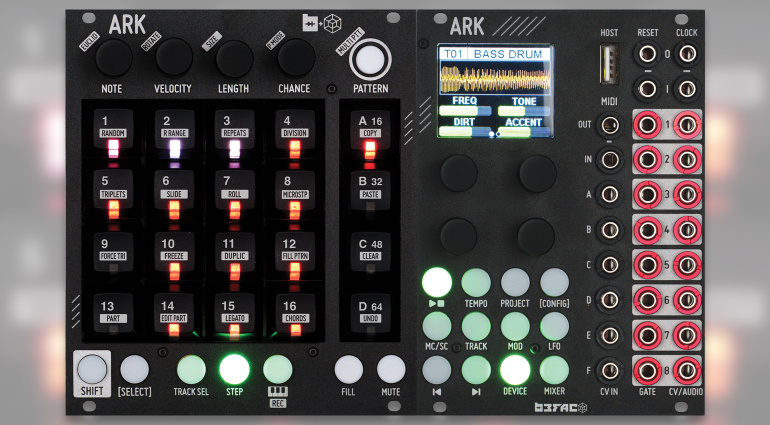
TL;DR: Befaco and Tesseract Modular have announced ARK, a 16-track sequencer that doubles as a synth and sample player in a clever split-module Eurorack format. It features stochastic and Euclidean sequencing, eight CV/gate pairs, an internal sound engine with 16 modulators, and a fully featured mixer with effects — all for €666 and a late 2026 release window.
- 16-track sequencer with stochastic, Euclidean, and up to 64-step patterns, outputting both MIDI and CV/gate.
- Split into two modules — sequencer unit and master unit with screen and I/O — for flexible placement in your rack.
- Internal synth engine and sample player per track, with 16 modulators, a mixer, effects, and master dynamics.
- Eight CV/gate output pairs, six CV inputs, MIDI In/Out, USB host for controllers, and CV outputs that double as audio outs.
- Price set at €666 (tax included), with release expected in late 2026.
Reading time: 3 min
Want more synth news before your next coffee break? Join the Noxal newsletter — no spam, just gear worth knowing about.
Meet ARK: The Sequencer That Refuses to Be Just a Sequencer

We at Noxal have seen a lot of modular announcements that promise the moon and deliver a paperweight. But every so often, something lands in our inbox that makes us put down our coffee and actually pay attention. The ARK, a collaboration between Befaco and Tesseract Modular, is one of those rare beasts. It’s a 16-track sequencer that also wants to be your synth, your sample player, and the nervous system of your entire Eurorack setup.
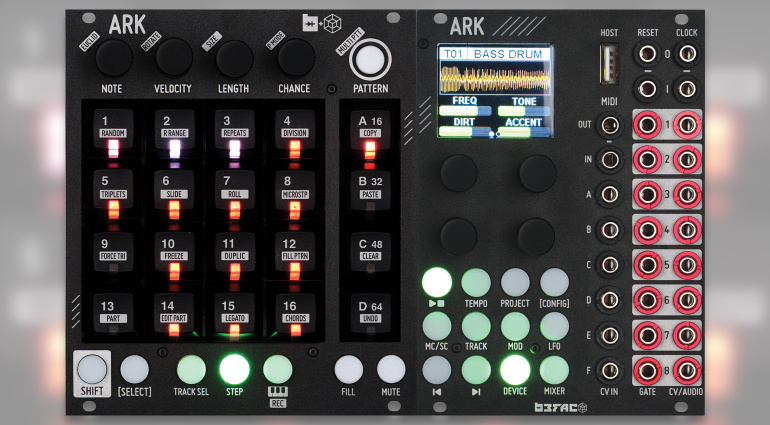
Let’s get the basics out of the way: ARK is a big, ambitious module. It offers stochastic and Euclidean sequencing modes, patterns up to 64 steps (I’m squinting at the panel render, but that’s my best guess), and outputs both MIDI and CV. There are eight CV/gate output pairs, six CV inputs, Clock In/Out, and Reset In/Out. You can also plug a MIDI controller directly into the module’s USB host port for external parameter control. That’s a lot of connectivity for a single module, and it suggests Befaco and Tesseract are aiming for something that can run an entire live set without breaking a sweat.
But here’s where it gets interesting: ARK isn’t just a sequencer. It’s also a self-contained instrument. Each track can be switched to run an internal synthesis engine or sample player, controlled by the sequencer or via MIDI. There are 16 internal modulators to twist those sounds, plus a fully featured mixer with effects and master dynamics. The CV outputs double as audio outputs, so you can route the internal sound engine to your mixer or other modules without needing extra cables. It’s like someone took a groovebox, a sequencer, and a modular mixer, then asked, “What if we made it modular?”
Split Form Factor: Workflow Freedom
One of the most refreshing things about ARK is its physical design. Instead of a single massive panel that dominates your rack, ARK is split into two separate modules: the sequencer unit and the master unit. The sequencer unit holds the big, Cherry-compatible keys — the kind that make you feel like you’re playing a proper instrument, not just tapping on a touch strip. The master unit houses the screen, configuration buttons, encoders, and all the I/O.
Why split them? Because workflow matters. You can place the sequencer unit where your hands naturally fall — say, bottom row, center — and the master unit somewhere you can see the screen and reach the controls without stretching. If you’re building a performance case, this is a godsend. If you’re a studio rat who likes to keep everything within arm’s reach, it’s still a smart move. We at Noxal appreciate when manufacturers think about ergonomics instead of just cramming everything onto one panel because it looks cool in a promo shot.
That said, the split design does mean you’ll need to budget for two sets of power headers and two spots in your case. Given that ARK is aiming to be the main hub of your system, that’s a reasonable trade-off. But if you’re running a small skiff, you might want to measure twice before committing.
Internal Sound Engine: A Modular Synth in a Sequencer
Let’s talk about that internal sound engine, because it’s what elevates ARK from “great sequencer” to “potential workhorse.” Each of the 16 tracks can be configured as a synth voice or sample player. The details are thin — Befaco hasn’t released the full spec yet — but we know there are 16 internal modulators to shape your sounds. That’s enough modulation to keep things interesting without needing a separate envelope or LFO module.
The sample player aspect is particularly intriguing. In a world where sample-based Eurorack modules are becoming more common (looking at you, Squid Salmple and bitbox), having sample playback integrated into your sequencer could streamline a lot of workflows. Imagine sequencing a bassline on one track, a drum loop on another, and a synth pad on a third, all from the same module, with the same clock, and routing everything through the internal mixer. It’s the kind of all-in-one approach that usually makes me skeptical — jack of all trades, master of none — but the specs here suggest ARK might actually pull it off.
The mixer with effects and master dynamics is the cherry on top. You can route the sequencer’s CV and the internal audio to separate outputs, or mix them together. The effects are unspecified, but if they’re anything like Befaco’s standalone modules (the Chopping Kinky, the Instrument Interface), they’ll be characterful and useful.
Market Context and Who Is This For
ARK enters a crowded field of “big” Eurorack sequencers. The Erica Synths Black Sequencer, the Five12 Vector, the Winterbloom Castor & Pollux — all offer deep sequencing with CV/gate outputs. But none of them also include a full synth engine, sample player, and mixer in the same package. That’s where ARK stands out. It’s not trying to be the best sequencer in isolation; it’s trying to be the centerpiece of a compact, self-contained system.
Who is this for? If you’re building a performance case and want to minimize external gear, ARK is a strong candidate. If you’re a studio user who wants to sequence external synths while also generating sounds internally, it could replace several modules. The €666 price tag (tax included) is surprisingly reasonable for what’s on offer — comparable to a high-end sequencer alone, but with a synth engine and mixer thrown in. Late 2026 is a long wait, but given the complexity of the design, I’d rather they take their time than rush a buggy firmware out the door.
We at Noxal will be watching this one closely. If ARK delivers on its promises, it could be the module that makes you rethink your entire rack. If it doesn’t, well, at least it’ll look good on the shelf while you wait for the bug fixes.
Frequently Asked Questions
When will the Befaco x Tesseract ARK be released?
According to Befaco, the release is planned for late 2026. That’s a long wait, but given the complexity of the module, it’s better to be patient than to receive a half-baked product.
How much does the ARK cost?
The price is set at €666, tax included. That’s competitive for a high-end sequencer with a built-in synth engine, sample player, and mixer.
Can I use the ARK without a case or power supply?
No. ARK is a Eurorack module (or rather, two modules) that requires a Eurorack case with power. The split design means you’ll need two separate power connections and two panel spaces in your rack.
I’ll be clearing a spot in my rack and brewing an extra-strong pour-over to sustain me through the wait until late 2026. If ARK is half as good as it sounds, it’ll be worth every cold cup of coffee along the way.