
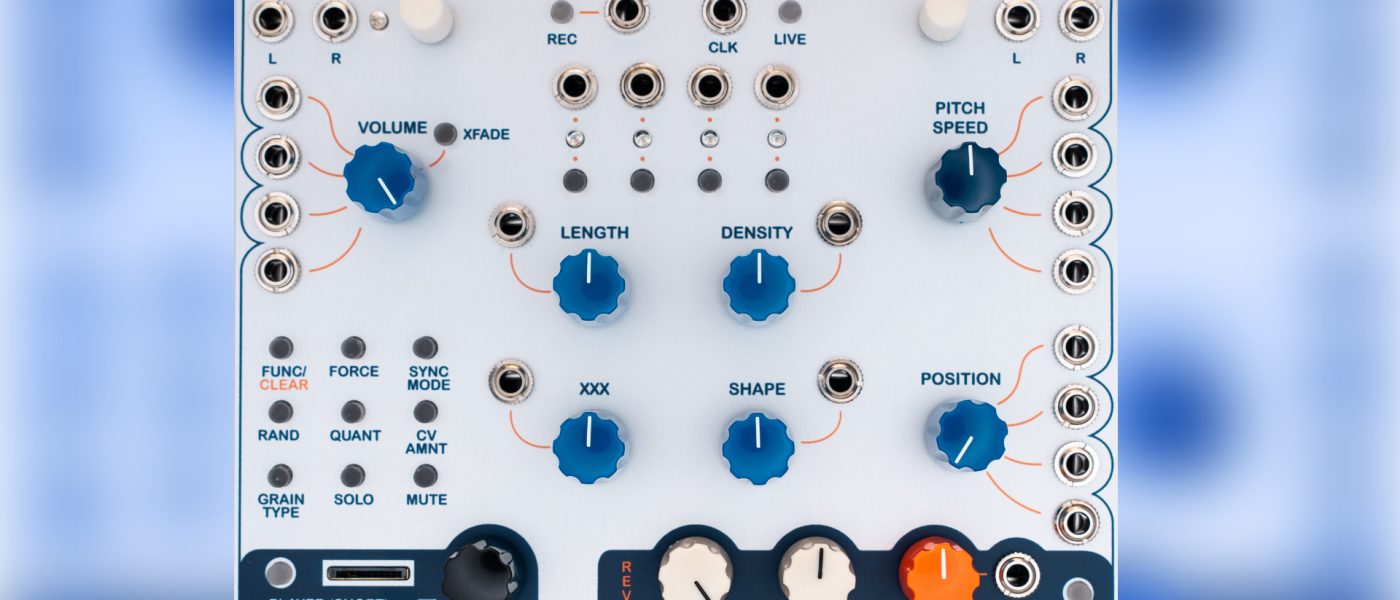
TL;DR: SBRK Devices, a new Spanish developer, has unveiled the Zerua Nahasi, a 30HP polyphonic granular synthesizer/sampler for Eurorack with four independent stereo granular engines, a convolution reverb loaded with impulse responses from Barcelona’s iconic spaces, and a live granular delay mode. After debuting at Machina Bristronica 2025, the module is now final and will be shown at Superbooth 2026, with availability expected by late 2025 or early 2026.
- Four stereo granular engines with varispeed, paulstretch, and onset/transient detection for precise sample slicing.
- Stereo sampling via line inputs or microSD card, with 20+ seconds of buffer per engine.
- Integrated stereo convolution reverb with built-in IRs from Barcelona landmarks and support for custom IRs.
- CV control over key parameters (volume, pitch/speed, position) per layer, plus global randomization.
- 30HP module with a deep back panel — not skiff-friendly, but built for hands-on tweaking.
Reading time: 4 min
Want more synth news before your next coffee break? Join the Noxal newsletter — no spam, just gear worth knowing about.

What Is the Zerua Nahasi?

We at Noxal have a soft spot for granular synthesis — it’s the sonic equivalent of taking a photograph, cutting it into confetti, and then asking the confetti to sing. The SBRK Devices Zerua Nahasi is exactly that, but in a 30HP Eurorack module that feels less like a science experiment and more like a musical instrument. Developed by a new Spanish outfit, the module made its first public appearance at Machina Bristronica 2025 and is now ready for its Superbooth 2026 debut.
The name “Zerua Nahasi” rolls off the tongue like a Basque lullaby, and the module itself is a polyphonic granular sampler/synthesizer that can handle up to four stereo voices simultaneously. Each voice is an independent granular engine with its own buffer, parameters, and routing options. The module’s depth — both literal and figurative — suggests it’s designed for serious studio use rather than skiff portability. But then, who wants to carry a skiff full of granular engines when you could just carry a laptop? Precisely. We want hardware that demands a proper rack.
Four Engines, One Mind
The core of the Zerua Nahasi is its four stereo granular engines, each capable of holding over 20 seconds of audio in its internal buffer. That’s enough for a decent vocal phrase, a field recording of a Barcelona fountain, or — let’s be honest — a single sustained note from a Juno. The engines can operate independently or be synced together, and there’s an Xfade knob that lets you morph between them. Think of it as a granular crossfader that turns your patch into a living, breathing cloud of sound.
Granulation modes include varispeed and paulstretch, with more promised via firmware updates. The inclusion of onset/transient detection is a particularly smart touch — it makes finding the right grains feel less like blindfolded dart-throwing and more like guided exploration. Each engine offers classic parameters: grain position, length, density, pitch/speed, envelope shape, and stereo image. There’s also built-in pitch quantization, which should keep things musical even when you’re dialing in chaos.
Sampling: Live and from SD
Getting audio into the Zerua Nahasi is refreshingly straightforward. You can sample in stereo via two 3.5mm mono jacks on the front panel, or load samples from a microSD card. Each engine can use the same sample or different ones, which opens up a world of layered textures. The live mode is particularly clever: it turns the module into a granular delay, processing incoming audio in real time. This is where the Zerua Nahasi shines as a performance tool — imagine feeding it a live drum loop and watching it splinter into a thousand rhythmic shards.
The internal buffer is generous at 20+ seconds per engine, but the real fun begins when you start loading custom samples from the SD card. The module supports stereo WAV files, and the workflow appears to be straightforward: load, slice, and mutate. We appreciate when a developer doesn’t hide the complexity behind a menu-diving nightmare. The Zerua Nahasi keeps its controls on the surface, where they belong.
Convolution Reverb: Barcelona in a Box
The integrated stereo convolution reverb is one of the Zerua Nahasi’s standout features. It ships with impulse responses (IRs) recorded in Barcelona’s most iconic spaces — think cathedrals, concert halls, and underground clubs. These aren’t just reverb presets; they’re sonic postcards from a city that knows a thing or two about sound. You can also load your own IRs from the SD card, which means you could theoretically capture the reverb of your own living room and use it to process your granular chaos.
Positioned at the end of the signal chain, the reverb acts as a global effect, gluing the four granular engines together into a cohesive whole. It’s a smart design choice — granular synthesis can easily become a muddy mess without a unifying spatial element. The convolution reverb provides that without adding digital harshness, which is more than we can say for some algorithmic reverbs we’ve heard in this price range.
CV and Randomization
No Eurorack module would be complete without CV control, and the Zerua Nahasi delivers. Parameters like volume, pitch/speed, and position have dedicated CV inputs for each of the four layers, while others are controlled globally. There’s also a built-in randomization function, which is perfect when you want to inject a little chaos without patching a separate random voltage source. It’s not quite the same as having a Wogglebug, but it’s close enough for most granular work.
The module’s depth (it’s not skiff-friendly) suggests that SBRK Devices expects users to have a proper case with ample power. The back panel reveals a dense PCB layout, which is reassuring — this isn’t a half-baked design. It’s a module that was built by someone who understands both the technical and musical demands of granular synthesis.
Market Context and Who It’s For
Granular synthesis in Eurorack is no longer a novelty. We’ve seen modules from Mutable Instruments (RIP), Qu-Bit, and more recently, Instruo and ALM Busy Circuits. The Zerua Nahasi enters a crowded field, but it brings a unique combination of features: four stereo engines, convolution reverb with real-world IRs, and a live delay mode. It’s not trying to replace your Clouds or your Arbhar; it’s offering a different approach, one that feels more like a complete instrument than a simple effects processor.
Who is this for? The granular enthusiast who wants more than a single voice. The modular user who values stereo processing and spatial depth. The performer who needs a live granular delay that doesn’t require a laptop. And anyone who appreciates a module that looks like it was designed by someone who actually uses the thing. The Zerua Nahasi is not for the faint of heart or the shallow of wallet — pricing hasn’t been announced yet, but expect it to reflect the complexity inside.
Frequently Asked Questions
When will the Zerua Nahasi be available?
SBRK Devices expects the module to be available by late 2025 or early 2026. The final price has not been announced, but the module will be on display at Superbooth 2026 for hands-on demos.
Can I use the Zerua Nahasi as a standalone granular delay?
Yes. The live mode allows you to process incoming audio in real time, effectively turning the module into a stereo granular delay. This is a key feature for live performance and sound design.
Does the module support custom impulse responses?
Yes. The integrated convolution reverb comes with built-in IRs from Barcelona spaces, but you can load your own WAV-based impulse responses from the microSD card for custom reverb textures.
We’ll be at Superbooth 2026 with a thermos of coffee, hunting for the best IR of a Berlin U-bahn station. If you see us, say hello — just don’t ask if we’ve tried the Zerua Nahasi with a field recording of a coffee machine. (We have. It’s beautiful.)